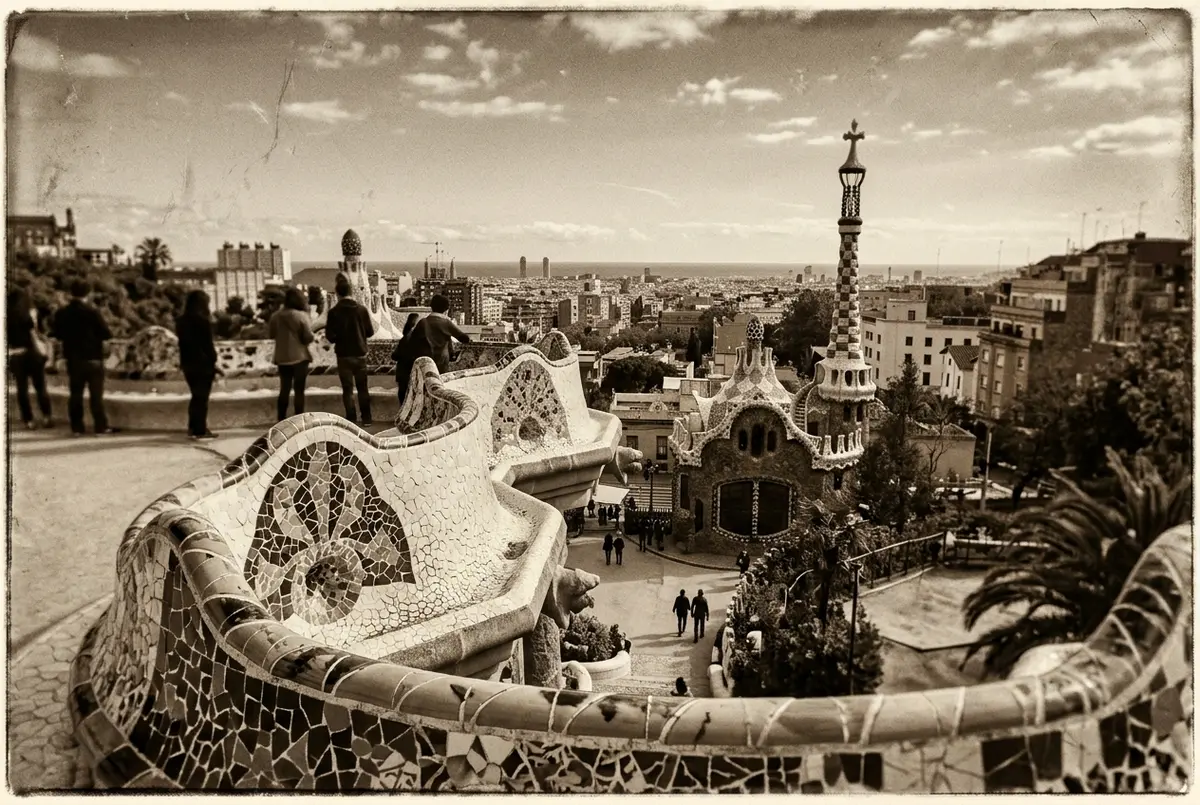
Park guell history starts somewhere most visitors never expect: a failed real estate project. In 1900, wealthy industrialist Eusebi Güell commissioned Antoni Gaudí to design a gated luxury housing estate on this hillside, modeled loosely on the English garden city idea, and it flopped so badly that only two of the planned residential lots ever sold. Here’s what I find genuinely useful about this history, beyond trivia: it explains why the park feels more like wandering through an abandoned private vision than a planned public space. My is Park Güell worth it guide covers whether that unusual backstory translates into a visit worth your time today.
Who Was Eusebi Güell, and Why Did He Commission This Park?
Eusebi guell park guell development traces back to one of Barcelona’s wealthiest industrialists, a textile and shipping magnate with an interest in English design trends who wanted to build an exclusive residential community for Barcelona’s upper class, away from the crowded city center below.
I’d call Güell more of a visionary patron than a conventional developer. He gave Gaudí unusual creative freedom for a commercial project, which is exactly why the result looks nothing like a typical turn of the century housing development.
What Was Park Güell Originally Meant to Be?
A gated estate of 60 triangular residential plots, complete with its own chapel, market hall and ornamental entrance pavilions, aimed at buyers who wanted a private, elevated retreat above Barcelona’s smog and noise. Gaudí designed the shared infrastructure, including the viaducts, stairways and the now famous Hypostyle Room, which was planned as a covered market for residents.
I’d say this original plan explains a lot of what still confuses first time visitors. The Hypostyle Room’s 86 columns look overbuilt for a simple park shelter because it was never meant to be one; it was meant to serve an entire residential community that never materialized.
Why Did the Housing Estate Fail?
Mainly location and timing. The site sat far enough from central Barcelona, and transportation links weak enough at the time, that wealthy buyers simply weren’t interested in relocating there, no matter how striking Gaudí’s design was. Only two lots sold, one to a lawyer and one eventually to Gaudí himself, who moved into a show house on the grounds in 1906.
I wouldn’t read the failure as a failure of the design. It’s a reminder that even extraordinary architecture can’t overcome a fundamentally unpopular real estate pitch, a pattern that still plays out in ambitious developments today.
How Did Antoni Gaudí Shape the Design?
Antoni gaudi park guell work spanned roughly 14 years, from 1900 to 1914, and it’s where you can see his style shift from the more ornamented, historicist approach of earlier projects toward the organic, nature inspired forms he became famous for. The viaducts mimic tree trunks, the stairways curve like natural paths, and the mosaic bench at Nature Square follows the curve of a snake rather than a straight architectural line.
I’d treat Park Güell as the clearest place in Barcelona to watch Gaudí’s style evolve mid project. Few other sites let you trace that shift this directly across more than a decade of continuous work by the same architect.

When Did Park Güell Open to the Public?
In 1926, four years after Eusebi Güell’s death and more than a decade after Gaudí stopped active work on the site. Barcelona’s city council bought the land from Güell’s heirs and converted it into a municipal park, opening the grounds, including the unsold residential lots, to the general public for the first time.
I’d call this the real turning point in the park’s history. What began as an exclusive private estate for Barcelona’s wealthy became, almost by accident, one of the most democratically accessible green spaces in the entire city.
When Was Park Güell Named a UNESCO World Heritage Site?
Park guell unesco world heritage status arrived in 1984, when UNESCO added it to the World Heritage list under the collective designation “Works of Antoni Gaudí,” which also covers the Sagrada Família, Casa Batlló, La Pedrera and Palau Güell among others.
I’d point out that this listing recognizes Park Güell specifically for its architectural and artistic value, not for being a pleasant park, which is worth remembering if you’re deciding whether the paid Monumental Zone earns its ticket price.
What Happened to Gaudí’s Own House in the Park?
Gaudí lived in the show house built to attract buyers for nearly 20 years, from 1906 until 1925, the year before the city turned the grounds into a public park. That same building is now the Gaudí House Museum, open separately from the main monumental zone with its own ticket, holding furniture and personal items connected to his life there.
I’d visit that museum specifically if the architect’s personal story interests you beyond the park’s visual highlights. It’s easy to miss since it sits slightly apart from the main mosaic terraces most visitors head straight for.
Why Does This History Matter When You Visit Today?
Because it reframes nearly everything you’ll see. The Hypostyle Room’s scale, the viaducts’ tree like structure, and even the park’s slightly unfinished feel in certain corners all trace back to a residential plan that was abandoned mid construction, not a park designed from scratch as a park.
I’d keep this in mind while walking the grounds, since it changes a few details from charming quirks into genuine historical artifacts. The empty space where more houses were meant to stand is still part of what you’re looking at.
How Does This History Connect to Gaudí’s Other Barcelona Work?
Park Güell sits alongside four other UNESCO listed Gaudí buildings in the city, and my complete Gaudí itinerary guide maps out how to see several of them in one trip, including the stylistic differences between this park and his later, more famous Sagrada Família.
I’d read that guide if the history here makes you want to trace Gaudí’s full body of work rather than stopping at just this one site.
What Should I Look at Closely Because of This History?
My Trencadís mosaic guide covers the broken ceramic technique Gaudí used throughout the park, a method partly born from budget constraints during the original estate project, not purely an artistic choice from the start.
I’d look at the mosaic surfaces differently once you know that detail. What looks like pure creative flourish was also, in part, a practical solution to building cheaply with leftover tile.
What Else Is Worth Seeing Given This Background?
My what to see inside Park Güell guide walks through the Hypostyle Room, Nature Square and the Austria Gardens with this same history in mind, which is worth reading if you want the context to actually change how you experience each stop rather than just knowing it as trivia.
I’d pair that guide with this one before your visit, since knowing both what to see and why it looks the way it does is where this history actually pays off.
Can I See Any of This Before I Actually Travel?
My Park Güell virtual tour guide previews the mosaic terraces and the view from Nature Square if you want a sense of what the finished part of this abandoned housing estate actually looks like before you commit to a ticket.
I’d use it mainly to picture scale. Photos alone tend to undersell how large the Hypostyle Room feels once you know it was built to be a market hall for a neighborhood that was never finished.
My Actual Take on This History
I find the failed housing estate detail more compelling than almost anything else about Park Güell, because it means the park you walk through today is essentially an accident of a failed business plan that happened to leave behind extraordinary architecture. That’s a far more interesting story than “a wealthy man built a pretty park.”
I’d share that detail with anyone visiting who seems lukewarm about adding Park Güell to their itinerary. Knowing the real history tends to make the visit land differently than approaching it as just another photogenic stop on a list.
Frequently Asked Questions
Who originally commissioned Park Güell?
Eusebi Güell, a wealthy Barcelona industrialist, commissioned it in 1900 as a luxury gated housing estate designed by Antoni Gaudí.
Why did the original housing project fail?
Mainly its distance from central Barcelona and weak transport links at the time. Only two of the planned residential lots ever sold.
When did Park Güell become a public park?
In 1926, after Barcelona’s city council purchased the land from Eusebi Güell’s heirs following his death in 1922.
When was Park Güell named a UNESCO World Heritage Site?
In 1984, under the collective listing “Works of Antoni Gaudí,” which also includes the Sagrada Família and several other Gaudí buildings.
Did Gaudí actually live in Park Güell?
Yes, in the estate’s show house, from 1906 to 1925. That building is now the Gaudí House Museum.
For more on the park’s design and listing, see the Park Güell Wikipedia entry.
My closing take: most visitors treat Park Güell as a photo stop and miss that they’re walking through the remains of a failed real estate gamble that, against all odds, became one of the most visited public spaces in Barcelona. Knowing that story is free, and I think it adds more to the visit than almost any other single fact about the park.
see current park guell tickets and tours before you go →