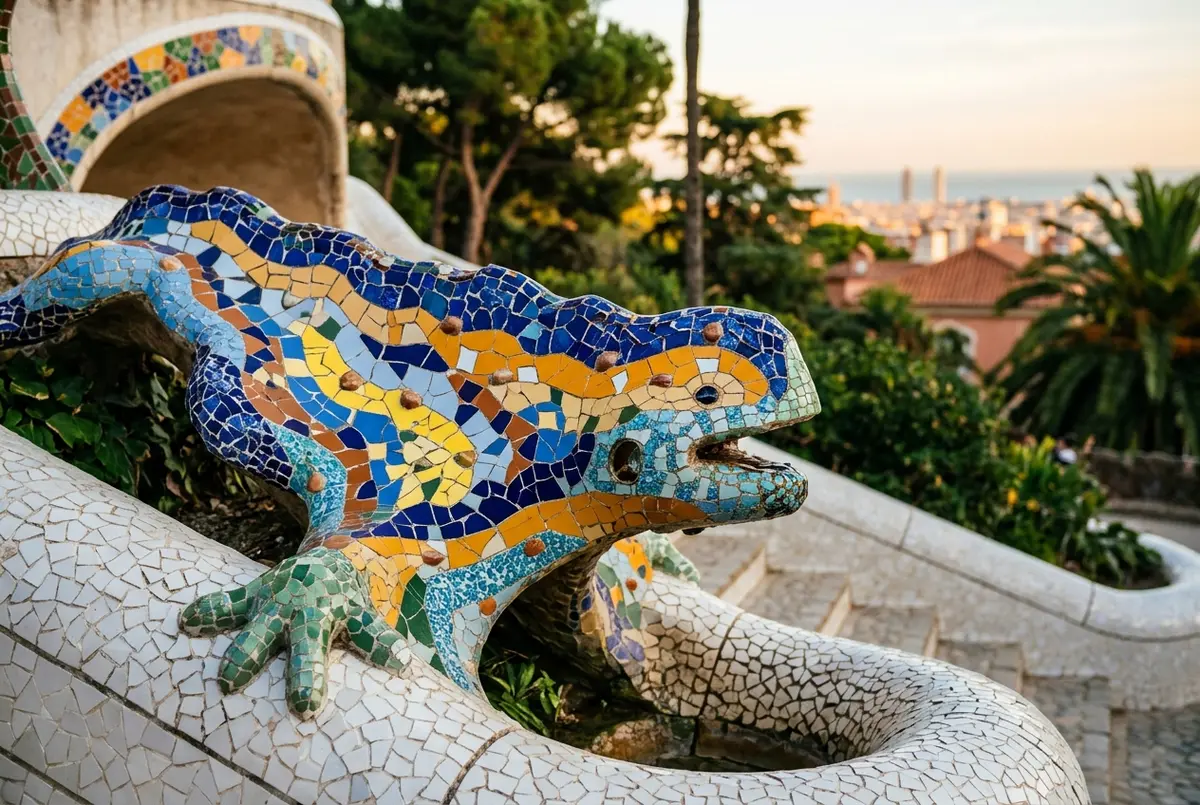
The park guell mosaic dragon stairway is built from trencadís, Gaudí’s technique of covering curved surfaces with shattered ceramic fragments instead of whole tiles. Here’s why this matters beyond trivia: it’s the single visual signature that separates Park Güell from every other garden or viewpoint in Barcelona, and once you understand how it’s made, you’ll start spotting it everywhere in the park, not just on the famous salamander. My is Park Güell worth it guide weighs this craft against the ticket price if you’re still deciding whether to visit at all.
What Is Trencadís, Exactly?
Trencadis mosaic park guell work means covering a surface with broken pieces of ceramic tile, ranging from fragments the size of a fingernail to small irregular shards, set into mortar in patterns that follow the curve of whatever they’re applied to. The word itself comes from the Catalan for “broken” or “shattered,” which is a fair description of the raw material before it becomes art.
I’d push back on anyone who calls this “just mosaic.” Standard mosaic uses cut, uniform pieces designed to fit a grid. Trencadís starts from literal waste, broken tile offcuts, and turns irregularity into the whole point of the style.
Why Is the Dragon Stairway’s Salamander Covered in Broken Tile?
Park guell salamander dragon, officially nicknamed El Drac, sits at the base of the main stairway and greets almost every visitor who enters through the central gate. Its curved, scaled body is exactly the kind of surface trencadís was built for: a shape no flat tile could wrap around cleanly, finished instead with hundreds of small ceramic fragments in greens, blues and yellows that catch light differently depending on where you stand.
I’d budget real time here rather than snapping one photo and moving on. The color shifts noticeably as you walk past it, which is something no single picture online actually captures.
Where Else in the Park Does Trencadís Appear?
Beyond the salamander, trencadís covers the undulating bench that wraps around the Nature Square terrace, the ceiling medallions inside the Hypostyle Room, and decorative details on the entrance pavilions near the main gate. It’s not a one-spot gimmick, it’s the connective visual language running through the whole monumental zone.
I’d actually argue the bench is the more impressive application once you look closely, since it covers a much longer, more complex curved surface than the salamander does, and most visitors walk right past that detail on their way to a photo.
How Was Trencadís Actually Made?
Workers broke ceramic tile, often factory offcuts and reject pieces, into irregular fragments, then set them into wet mortar over a curved form by hand, piece by piece, with no two sections following an identical pattern. There was no template for this, the irregularity itself was the design logic.
I’d call this one of the more labor intensive decorative techniques in European architecture from this period, precisely because it couldn’t be mechanized or standardized the way flat tilework could.
Why Did Gaudí Choose Broken Tiles Instead of Whole Ceramic?
Partly necessity, partly vision. Park Güell’s original housing estate project ran on a tight budget, and broken, rejected tile from local factories was far cheaper than custom whole ceramic. Gaudí turned that constraint into a visual identity rather than hiding it.
I’d remember this the next time anyone calls Gaudí’s style purely whimsical. A good chunk of what looks like pure artistic freedom was also a practical answer to a real cost problem, which makes the result more impressive, not less.
Is the Wavy Bench at Nature Square the Best Example of This Style?
Yes, by scale if nothing else. The bench curves continuously around the entire terrace, covered edge to edge in trencadís in a shifting pattern of colors that never quite repeats, following the natural wave of the seating rather than a fixed grid.
I’d rank this above the salamander for anyone who wants to understand the technique rather than just photograph a famous detail. Running a hand along the surface, where it’s permitted, makes the irregularity of the fragments much more obvious than any photo does.
How Does Trencadís Differ From Traditional Mosaic Technique?
Traditional mosaic, like Roman or Byzantine work, typically uses small, cut, roughly uniform pieces called tesserae, arranged into deliberate pictures or patterns on flat or gently curved surfaces. Trencadís uses irregular, randomly shaped fragments and leans into that randomness rather than smoothing it out, and it was developed specifically to cover the complex, organic curves Gaudí favored.
I’d say the real difference is intent. Traditional mosaic controls for uniformity; trencadís controls for texture and movement instead, which is exactly why it suits Gaudí’s curved, nature inspired architecture so well.
Does Gaudí Use This Style Anywhere Else in Barcelona?
Yes, though Park Güell remains the largest and most famous application. Casa Batlló’s facade uses a related trencadís treatment on its shimmering exterior, and smaller touches appear across his other UNESCO listed buildings as part of his broader gaudi architecture style.
I’d still call Park Güell the best single place to study the technique, since the scale here, an entire terrace bench plus a monumental stairway, gives you more surface area to actually see the pattern logic than a single building facade does.
Can I Get Close Enough to See the Individual Fragments?
Yes, in most spots, since the Dragon Stairway and the Nature Square bench sit at normal walking height with no barrier keeping you at a distance. Standing close is actually necessary to appreciate the fragment level detail; from far away, trencadís just reads as a colorful blur.
I’d recommend alternating your distance deliberately: a wide shot to capture the overall shape, then a close pass specifically to see the individual broken pieces and how irregularly they’re cut.
Why Does This Craft Connect Back to the Park’s Backstory?
Because the budget pressure that produced trencadís traces directly to the failed housing estate Gaudí was originally building here. My Park Güell history guide covers how that abandoned development shaped almost everything you see in the monumental zone today, this mosaic style included.
I’d read that history alongside this one, since knowing why the budget was tight changes how you look at every broken tile in the park.
What Else Should I Plan to See Inside the Park?
Beyond the mosaic highlights, my what to see inside Park Güell guide walks through the Hypostyle Room and the Austria Gardens in the order most visitors actually encounter them, which pairs well with focusing on trencadís specifically here.
I’d use that guide to build your full visit plan, then come back to this one when you’re ready to look closely at the mosaic details themselves.
Can I Preview the Mosaics Before I Book a Ticket?
Yes. My Park Güell virtual tour guide rounds up the best photo previews of the salamander and the wavy bench if you want to judge whether this style genuinely appeals to you before committing to a visit.
I’d treat that preview as a decision tool rather than a substitute, since photos consistently undersell the texture and color variation you only notice standing a few feet from the real tilework.
Where Should I Go to Photograph These Mosaics Well?
My best photo spots guide covers the exact timing and framing that gets a clean shot of the salamander and the bench without a crowd cutting across the tilework.
I’d book the earliest slot you can manage if a good photo of the mosaics matters to you, since both main trencadís spots narrow to a single clear walkway that fills up fast once the park gets busy.
My Actual Take on the Trencadís Style
I think trencadís is the real reason Park Güell sticks in people’s memory longer than most other Barcelona sights. It’s not a building you walk through once and forget, it’s a texture you keep noticing new details in, from the salamander’s color shifts to the bench’s never quite repeating pattern.
I’d tell anyone deciding whether the ticket is worth it to weigh this craft specifically, not just the view. Plenty of Barcelona sights offer a good skyline photo; very few offer a decorative technique this unusual, made from what was originally broken factory waste.
Frequently Asked Questions
What is trencadís at Park Güell?
A broken ceramic mosaic technique Gaudí used to cover curved surfaces, most famously the Dragon Stairway’s salamander and the Nature Square bench.
Why does the Park Güell salamander use broken tile instead of whole pieces?
Broken fragments wrap around its curved body far better than flat tile could, and using reject ceramic also kept the original project’s costs down.
Is the Nature Square bench made the same way as the salamander?
Yes, both use trencadís, though the bench covers a far longer, more continuously curved surface than the smaller salamander figure.
Does Gaudí use trencadís on any other Barcelona buildings?
Yes, Casa Batlló’s shimmering facade uses a related trencadís treatment, though Park Güell remains the largest example of the technique.
Can I touch the mosaic surfaces at Park Güell?
In most spots along the stairway and the bench, yes, since there’s no barrier keeping visitors at a distance, though you should always follow any posted signage on site.
For more on the technique itself, see the Trencadís Wikipedia entry.
My closing take: the broken tile under your feet and under your hand at Park Güell is doing more storytelling than almost anything else in the park, about a tight budget turned into a signature style that nobody else has quite copied since. Look closely at it, not just the overall view, and I think the visit lands differently.
see the park guell tickets that get you close to the mosaics →